Column · @franciscopmjd936
ADA Portable Commode Rental: Recognizing Exemptions and General Demands
Renting portable washrooms seems simple until availability gets in the conversation, and it should. For event coordinators, property managers, contractors, colleges, churches, and households preparing large celebrations, the concern generally gets here late and with some anxiety: do we need an ADA mobile bathroom, and if so, just how many?
That unpredictability is easy to understand. Mobile restrooms sit at the crossroads of short-term logistics and permanent civil-rights responsibilities. Individuals tend to think that since a setup is short term, the regulations are lighter or more adaptable. In practice, accessibility still matters, and the federal standards do not go away even if the toilets arrived on a trailer instead of being developed right into a wall.
The basic structure is clear. In the United States, the regulating government access standard for portable toilet rentals is the 2010 ADA Requirements for Accessible Design, as translated by the Division of Justice and the Gain Access To Board. For a lot of basic usages, an obtainable device is not optional window clothing. It belongs to what makes a bathroom configuration functional by the public.
Where people obtain floundered remains in the details. They hear about an exemption for building and construction websites and presume it applies more broadly than it does. They buy a larger unit with a sticker label on the door and presume that alone makes it compliant. Or they count the number of commodes on site however neglect that the guideline applies by cluster, not just by the grand total spread across a property.
This is where cautious preparation helps. If you understand the narrow exception, the 5 percent rule, and the core physical demands for an obtainable configuration, you can make far better choices early and avoid the pricey shuffle that takes place when the devices are currently delivered.
The inquiry behind the rental order
When a person asks for an ada mobile bathroom leasing, they are usually asking 3 various inquiries at once.
First, they would like to know whether the regulation requires an easily accessible system at all. Second, they wish to know whether a specific device being used by a supplier really certifies as an ada certified mobile commode. Third, they want to know whether putting that system someplace on the site suffices, or whether the surrounding conditions additionally have to be accessible.
All 3 matter.
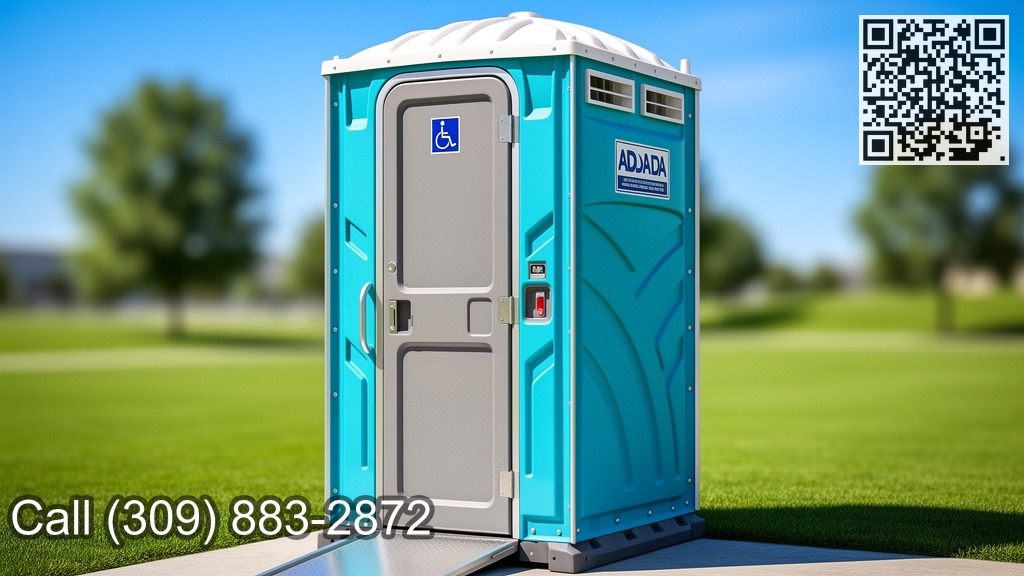
An ada accessible mobile toilet is not simply a bigger box with a bigger door. Accessibility relies on the device itself, the number of easily accessible devices are provided within each cluster, how the unit is identified, and whether a person can reach it and use it. That last factor obtains overlooked more than it should. A compliant-looking system set past irregular ground, blocked by challenges, or gotten to just by a noncompliant ramp can still produce significant accessibility problems.
What the federal conventional in fact controls
The controling benchmark is the 2010 ADA Standards for Accessible Design. That is the federal recommendation factor for access, and it relates to mobile commode leasings via the interpretations utilized by the Department of Justice and the Gain Access To Board.
That issues because a great deal of conversations in the field still wander towards routine or vendor shorthand. Somebody may claim, "We constantly go down one handicap system if the consumer asks," or, "It's short-lived, so the normal rules don't truly use." Those are not secure presumptions. The managing standard is not what a vendor normally does. It is the ADA criterion and its applicable technical and scoping requirements.
For portable toilet configurations made use of by the public, the accessible-unit demand stays important also at momentary events. Temporary does not mean excluded. A celebration that lasts one weekend break, a church charity event, a school field day, and a seasonal area event can all elevate the same availability issues.
The 5 percent regulation, and why the word "collection" matters
One of the clearest regulations in this area is the scoping requirement for portable single-user toilet units. A minimum of 5 percent of the systems in each collection should be accessible. The Accessibility Board has explained that this uses even at momentary events.
That expression, "in each cluster," should have emphasis. Individuals usually complete all restrooms across a website and afterwards think they are covered if one available device shows up someplace in the matter. Yet the regulation concentrates on the collections of units, not just the total event inventory.
Imagine a large outside occasion with mobile toilets put in numerous different areas throughout the premises. If those places work as distinctive collections, availability needs to be thought about at each collection, not simply at the site as a whole. An individual should not be expected to travel throughout the location to discover the only obtainable choice while everyone else has a nearby basic unit.
This is one of one of the most usual preparation mistakes since it often tends to show up late. Theoretically, the total device matter looks penalty. On the ground, the obtainable commode is parked in the wrong place.
For consumers asking about ada compliant mobile toilets, this is often the very first factor that changes the order. It is not only an issue of whether you have one available device. It is a matter of just how your toilet format is organized.
The narrow construction-site exemption
Now for the item that creates one of the most confusion.
There is an acknowledged difference including portable commode devices at construction websites utilized exclusively by construction employees. Those units are excluded from the portable-toilet availability scoping need in the cited 1991 standard. That is a specific carve-out, and it is not a blanket exception for anything happening near building and construction or on rough ground.
The key word is solely. If the portable bathrooms are for construction workers just, that exception belongs to the legal conversation. Once people stretch that logic past its real limits, difficulty starts.
A mixed-use website changes the picture. A project with visitors, members of the general public, or various other non-construction individuals raises a different collection of considerations. Likewise, a general mobile toilet leasing for an occasion, public event, or customer-facing setting does not drop under that slim construction-personnel exception.
This is why it helps to slow down and ask a plain-language concern before leasing. Who will be using these systems? If the solution includes the public, visitors, participants, customers, , pupils, or families, you are no more in the risk-free region of a construction-only assumption.
People often acquire the phrase "building site" as though it solves whatever. In practice, the much better lens is use, not ambience. Mud, secure fencing, equipment, and temporary problems do not automatically develop an exemption. Unique usage by construction employees is what matters in the exception defined here.
What makes an accessible portable washroom greater than a label
A system can not come to be compliant by marketing language alone. Terms like ada handicap available portable toilet, ada certified accessible mobile washrooms, or ada-compliant portable bathrooms sound reassuring, but the actual needs are practical and physical.
Accessible mobile bathroom systems should be related to the International Symbol of Availability. That is a noticeable and integral part of compliance due to the fact that individuals need to be able to situate the obtainable option without uncertainty. Still, signs is just one piece.
The units should also have an available course and entrance. If ramps or landings are needed, those functions have to adhere to the ADA technical demands. This factor often tends to amaze people due to the fact that they focus on the commode box itself and forget that the path to it matters just as much.
Anyone that has worked around short-term websites has seen just how easily access can be weakened by positioning. A vendor may supply an ada portable bathroom that is perfectly appropriate theoretically, only for it to be established on an unequal area, crowded by barriers, or separated behind a grade modification that makes entrance challenging or impossible. The requirements do not stop at the door.
Inside the system, the bathroom area technical requirements likewise enter into play. That includes component clearances, transforming area, and door handling clearances, in addition to the appropriate grab-bar and water-closet clearance guidelines. Those are technical needs, and they exist because usability depends upon more than a bigger impact. A person using a mobility device or other movement aid requires adequate space to strategy, enter, shut the door, turn, position, and transfer as intended.
This is why a real ada compliant mobile toilet is not interchangeable with a just spacious portable device. More space is practical, yet the setup and clearances are what identify whether the room functions accessibly.
Temporary occasions still lug genuine obligations
Short-term events are where misunderstandings multiply. Coordinators are juggling permits, vehicle parking, climate, volunteers, shipments, and group flow. Bathroom services come to be one more line item, and availability can get decreased to an easy amount question.
But temporary events are particularly component of the discussion here. The Access Board has said the 5 percent accessible-unit demand uses also at short-term occasions. That implies a one-day fundraising event or weekend fair should not be dealt with as if availability is optional because the arrangement is fleeting.
In real life, this commonly comes to be a placement concern more than a procurement issue. Organizers might rent out the appropriate variety of ada compliant portable toilets however position them in a manner that isolates them from the occasion's functional center. An available course that exists just on a website map, not on the ground, is a problem.
The thoughtful technique is to intend the toilet area the means you would certainly intend easily accessible car parking or an entryway. Where are individuals showing up? Where are the main courses of travel? What terrain changes or squeeze factors will matter when the group fills out? Those concerns are illegal facts. They shape whether a visitor can use the occasion with dignity.
Why "one available device" is not constantly enough
There is a solid temptation to assume in minimums. If a consumer listens to "5 percent," the mind instantly turns toward the tiniest possible number that might please the guideline. That is reasonable, particularly when spending plans are tight.
Still, minimal compliance and practical access are not always the exact same thing in practice.
If systems are split into multiple clusters, the math may require easily accessible systems in more than one area. If website traffic is heavy, a single accessible system might develop lengthy waits that overmuch impact customers who need it. If a website is big, one properly classified ada mobile toilet placed far from the main flow may meet neither the spirit neither the useful feature of accessibility.
This is where judgment issues. The law provides the framework, yet excellent planning asks a 2nd inquiry: will certainly a person sensibly be able to find and use this toilet with the exact same standard benefit offered to others?
That is commonly the distinction in between a checkbox approach and a respectful one.
The course to the unit can make or break compliance
Among all the ada portable toilet needs, the obtainable path is just one of the easiest to underestimate.
People photo compliance as a property of the unit. They forget that access begins long before the door swing. If the course is blocked, unsteady, steep, or broken up by features that need a noncompliant ramp or touchdown, the arrangement can stop working users also if the portable toilet itself was manufactured to the appropriate technical layout.
The criteria need an accessible route and entry, and when ramps or touchdowns are needed, those functions have to adhere to ADA technological requirements. That puts obligation on the wider configuration, not simply the vendor's devices inventory.
For planners, this implies the delivery place is not an afterthought. It belongs to compliance. A strong, sensibly accessible method issues. So does preventing last-minute field improvisation, like establishing the accessible unit https://privatebin.net/?6c394acde9436a20#Cqu1TzNy9Eok6LvVH1DYP3Sf8umDvZX4uBMoADNu6Ltt anywhere there is room after the conventional units are currently in place.
The most preventable blunders happen when accessibility is managed at the end of the format process rather than the beginning.
What tenants need to ask prior to delivery day
If you are renting out for a public or guest-facing setup, it aids to ask direct questions early. You do not need a lawful seminar. You require clarity about the device, the matter, and the site plan.
Here are the useful concerns that usually matter most:
- Is the unit being provided intended to work as an ada compliant portable bathroom, not just a larger basic model?
- How several restroom clusters will exist on the website, and does each collection have the required obtainable coverage?
- Will the system be understood the International Icon of Accessibility?
- Is the planned course and entry accessible, consisting of any ramp or landing that may be needed?
- Has the final placement been evaluated with the real website problems in mind, not just the order sheet?
Those five inquiries tend to reveal most preventable issues prior to the truck arrives.
Common misconceptions that bring about poor setups
Over the years, the same mistaken assumptions tend to appear again and again. They are worth naming clearly because they seem affordable till you compare them to the actual requirements.
The very first misunderstanding is that short-term ways exempt. It does not. The 5 percent rule still applies at short-lived events.
The secondly is that a person obtainable device somewhere on the residential or commercial property resolves the concern. It may not, particularly when toilets are organized in different clusters.
The 3rd is that the construction-site exemption applies whenever a setup feels tough or occupational. It does not. The exception explained right here is linked to mobile systems utilized solely by building and construction personnel.
The 4th is that signage alone confirms compliance. Identification with the availability icon is required, yet it is just one component of the overall picture.
The fifth is that the system can be certified even if the course to it is not. The criteria need an obtainable course and entry, and that bordering context matters.
When clients recognize these factors early, the rental discussion becomes much easier and far more productive.
A more comprehensive compliance climate is forming expectations
Accessibility enforcement does not exist in a vacuum, and it is useful to identify that. A pertinent 2026 growth highlights the more comprehensive direction of ADA conformity task: the Department of Justice extended the target date for state and local government internet and mobile ease of access policies to April 26, 2027 for larger entities.
That upgrade is not about portable commodes particularly, yet it signals something essential. Access is being implemented and reviewed across even more components of organizational life, not less. Physical access, digital gain access to, public-service gain access to, and temporary-access inquiries significantly rest within the same wider compliance culture.
For anyone in charge of facilities, events, or public accommodations, that more comprehensive climate ought to motivate a more severe strategy to details like ada certified portable washrooms. Not because portable toilet rentals are extravagant or high profile, however due to the fact that they belong to whether people can participate totally and with dignity.
The human side of a technical requirement
It is simple to let a subject such as this ended up being abstract. Percentages, route needs, technological clearances, symbols, scoping exceptions. Every one of that is required, yet none of it is the real reason access matters.
The genuine reason is that a restroom is not optional framework. When easily accessible washroom access is missing, people notice fast, and they pay the cost directly. They leave early. They rely on help they need to not need. They are compelled to plan around a barrier that others hardly register.
That is why the distinction in between an ada portable restroom and a typical system can not be dealt with as cosmetic. It impacts whether somebody can continue to be at an event, do their work, participate in a service, support a youngster, or take part in public life without avoidable embarrassment or hardship.
The law offers us the structure. Excellent operators, careful organizers, and conscientious occupants consider that framework sensible effect.
Getting it right without overcomplicating it
For most non-exempt mobile toilet leasings, the course is relatively straightforward once the complication is stripped away. Use the 2010 ADA Standards for Accessible Layout as the controlling government standard. Keep in mind that for collections of mobile single-user devices, at least 5 percent in each collection should come, including at short-term events. Make sure the available unit is identified with the International Sign of Availability. Verify that there is an accessible course and entrance, with any type of called for ramps or landings satisfying the appropriate technical requirements. And do not neglect that the system itself should satisfy the technical toilet-room needs that regulate clearances, maneuvering room, and associated features.
Treat the construction-personnel exemption carefully and narrowly. It is not a shortcut for public rentals.
If you come close to ada mobile commode rental with that said mindset, the process becomes much less murky. Much more significantly, the outcome is much more useful for the people who depend on it. That is the standard worth aiming for, whether you are ordering one ada-compliant mobile bathroom or working with several banks of ada compliant mobile toilets throughout a big momentary site.
 Ask ChatGPT
 Ask Grok
 Ask Perplexity
 Ask Claude
 Ask Google AI
 Ask You